

01The client
KNOW/AO Jurídico is the legal department of a group of seven companies, in sectors as different as logistics, private security, agriculture and technology. A team of lawyers handles requests from all of them: contracts to review, templates to draft, disputes, compliance and advice.
02The problem
Requests came in by email, by phone and in conversation. Each lawyer knew what they had on their plate, but nobody had the full picture. That had three costs:
- Requests with no clear owner: whoever asked did not know who was dealing with it, or how far along it was.
- Deadlines with no measure: there was no simple way to know how long each type of request took, or what was running late.
- Versions circulating by email: when it came to approval, it was not always clear which document was the final one.
And the legal department answers to seven companies, each wanting to see only what is theirs, with confidential matters in the mix.
03The solution
MCIT built KNOW/AO Jurídico, a legal request platform under the legal department's own brand, in Portuguese and English.
For those making requests
Open a request in a few steps, with the type of matter, attachments and the desired deadline. Follow the conversation with the lawyer, invite colleagues, answer requests for information and approve the final version.
For the legal team
Work queues, including a confidential one, requests with an owner, handover to colleagues with a note, review by a second lawyer, document versions, templates under each company's brand, time logging and a team calendar.
For those in charge
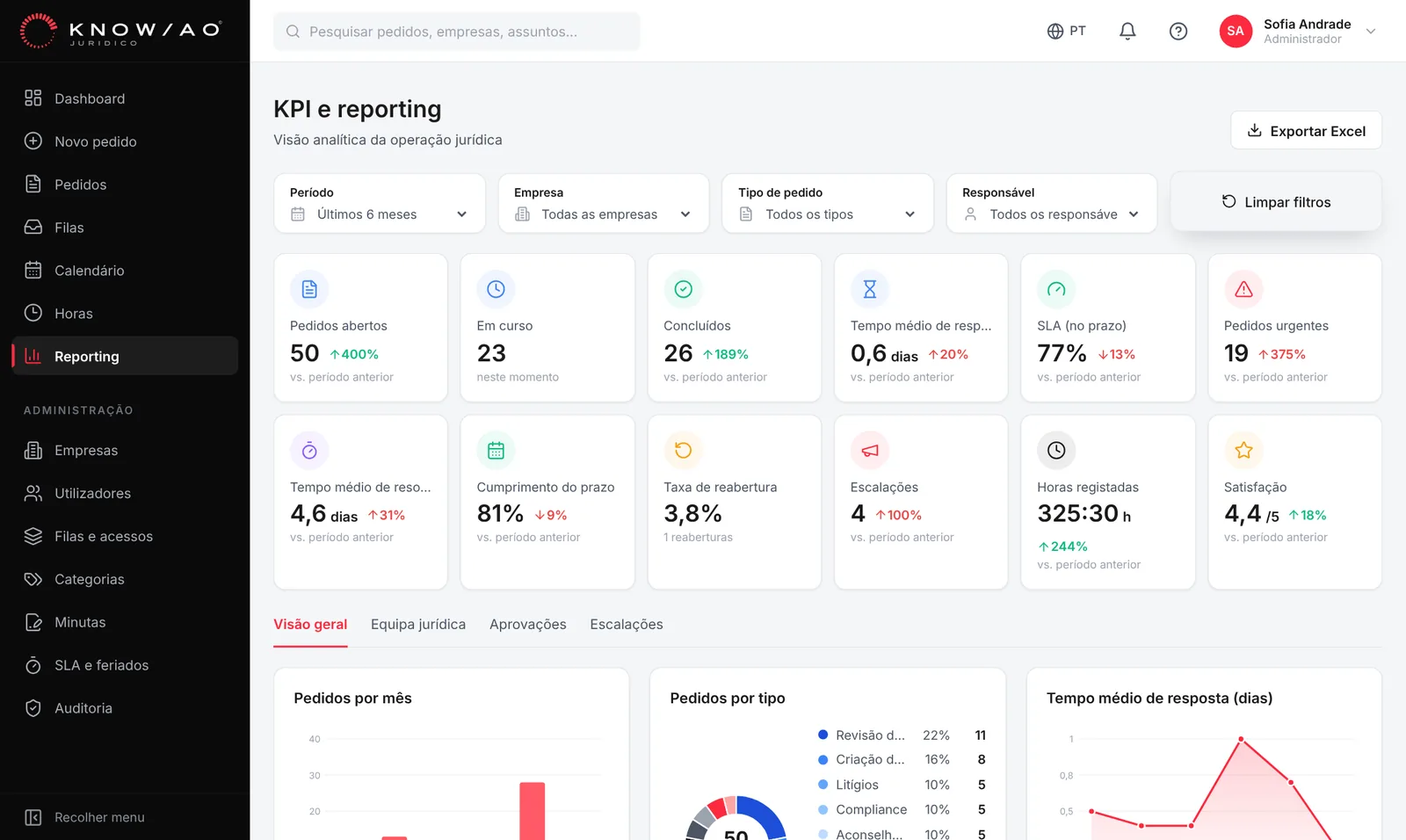
Operational indicators: deadline compliance, response times, satisfaction, escalations and hours per company, with spreadsheet export and an audit log of everything that happens.
Each company in the group sees only its own requests, and a confidential request is seen only by those involved in it.
04From request to approval
Every request follows a clear cycle, with a deadline measured in working hours that only runs when the next step is down to the legal team:
- The request goes into the general queue or the confidential one, and the deadline is calculated according to priority, counting only working days and leaving out public holidays.
- A lawyer takes on the request and becomes its owner. If they need information, they ask for it, and the deadline is paused until the reply comes in.
- When the type of matter requires it, the response goes through a second lawyer before moving on. Nobody reviews their own work.
- If there are approvers, the final version goes for approval, and each decision is recorded against the exact version of the document. A rejection sends the request back to the lawyer, with a reason.
- Whoever made the request closes it and rates the service from 1 to 5. If needed, they can escalate it, and the priority goes up.
Reminders take care of themselves: unanswered requests for information, pending approvals and deadlines about to expire alert whoever needs to act, without anyone having to remember.
05The results
- Seven companies in the group work on a single platform, each seeing only what is theirs.
- Five profiles, from staff member to administrator, with adjustable permissions and approvers designated person by person.
- Thirty-three templates under each company's brand, generated from the request itself.
- Deadlines measured in working hours, with public holidays, pauses and automatic reminders.
- A built-in manual that explains thirty-two operations, in Portuguese and English.
- From the first version to the platform in production in just over a week, with fifteen versions delivered.
The deadline only runs when the next step is down to the legal team.
Every approval decision is tied to the exact version of the document.
Each company sees what is theirs. What is confidential stays confidential.